
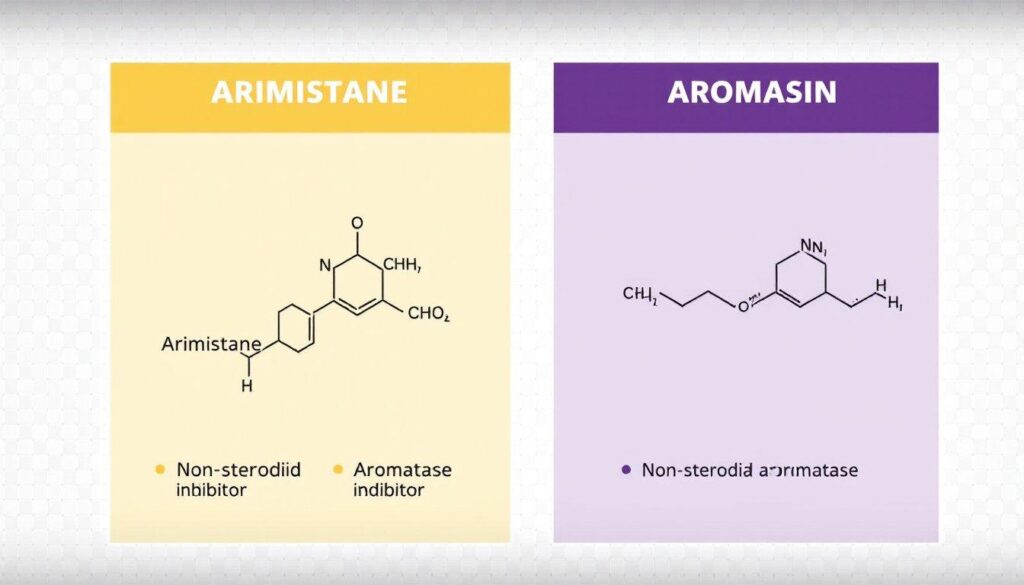
Arimistane and Aromasin are often discussed in the same bodybuilding conversations because both are associated with controlling estrogen. They are not, however, interchangeable compounds.
Aromasin is the brand name for exemestane, a prescription steroidal aromatase inhibitor with extensive pharmaceutical and clinical research behind it. Arimistane, chemically known as androsta-3,5-diene-7,17-dione, became popular through the sports-supplement and bodybuilding market and has been promoted as an aromatase inhibitor, particularly in products aimed at hormone management and post-cycle support.
The basic goal behind both compounds is similar: reducing the conversion of androgens into estrogens by interfering with the aromatase enzyme.
The major difference in Arimistane vs Aromasin is the strength of the evidence, pharmaceutical status, and predictability of the estrogen-lowering effect.
What Is Arimistane?
Arimistane is androsta-3,5-diene-7,17-dione, a steroidal compound that has been marketed extensively in bodybuilding supplements as an aromatase inhibitor.
The U.S. Food and Drug Administration has described Arimistane as a synthetic steroidal compound with aromatase-inhibiting activity.
Unlike ordinary sports supplements such as creatine or amino acids, Arimistane interacts with steroid hormone pathways.
This is why it became popular in products marketed for:
- estrogen management;
- maintaining a harder-looking physique;
- reducing the appearance of water retention;
- supporting testosterone-to-estrogen balance;
- post-cycle formulas;
- cutting and recomposition phases.
Its reputation in bodybuilding grew largely from supplement-industry use rather than from large clinical trials.
Human research on Arimistane remains limited compared with pharmaceutical aromatase inhibitors.
That distinction becomes important when comparing Arimistane vs Aromasin.
What Is Aromasin?
Aromasin is the pharmaceutical brand name for exemestane.
Exemestane is a steroidal aromatase inhibitor originally developed for the treatment of hormone-sensitive breast cancer. The FDA describes it as an irreversible steroidal aromatase inactivator.
Aromatase is the enzyme responsible for converting certain androgens into estrogens.
Two important examples are:
testosterone → estradiol;
androstenedione → estrone.
Exemestane resembles the natural androgen substrate androstenedione. Aromatase begins processing exemestane as though it were a normal substrate, but the resulting intermediate binds irreversibly to the enzyme and disables it.
This is why Aromasin is sometimes described as a suicide aromatase inhibitor.
The enzyme effectively participates in its own inactivation.
Arimistane vs Aromasin: Why Bodybuilders Compare Them
The comparison mainly exists because estrogen can become an important variable when anabolic-androgenic compounds are used.
Testosterone is the obvious example.
A portion of testosterone can be converted into estradiol through aromatase.
When androgen exposure becomes much higher than normal physiological production, more substrate may be available for aromatization.
Bodybuilders therefore often pay attention to estrogen-related changes such as:
water retention;
changes in muscular definition;
breast-tissue sensitivity;
changes in libido;
mood;
and overall hormonal balance.
Both compounds entered bodybuilding discussions as possible ways of influencing that pathway.
But Arimistane vs Aromasin is not simply a comparison between two equivalent estrogen blockers.
Aromasin is a pharmaceutical aromatase inhibitor with well-characterized pharmacology.
Arimistane has a much smaller human evidence base.
How Does Aromasin Work?
Aromasin works by irreversibly inactivating aromatase.
This separates it from reversible aromatase inhibitors, which occupy the enzyme temporarily.
Exemestane is structurally related to androstenedione and acts as a false substrate for aromatase. Once processed, it forms an intermediate that binds permanently to the enzyme’s active site.
The body must then produce new aromatase enzyme before normal enzyme activity can fully return.
This mechanism gives Aromasin a very specific pharmacological profile.
For bodybuilding discussions, the practical significance is straightforward:
Aromasin can substantially reduce estrogen synthesis.
Its effects are also comparatively predictable because exemestane has undergone extensive pharmacological and clinical investigation.
That evidence base is one of the largest differences in Arimistane vs Aromasin.
How Does Arimistane Work?
Arimistane has also been studied as an aromatase-inhibiting steroidal compound.
Its chemical structure is androsta-3,5-diene-7,17-dione.
Older biochemical research examined steroidal structures of this type for their ability to interfere with aromatase, and the FDA’s scientific assessment identifies Arimistane as having aromatase-inhibiting properties.
Where the comparison becomes less straightforward is human evidence.
Arimistane does not have the extensive controlled clinical data available for exemestane.
Research has investigated its metabolism and detection in humans, including anti-doping studies identifying multiple urinary metabolites after administration.
That confirms that Arimistane is biologically processed as an active steroidal compound.
What remains much less clearly established is exactly how much it lowers estradiol in different groups of men under real bodybuilding conditions.
That is why Arimistane’s reputation relies more heavily on supplement-industry experience and bodybuilding reports.
Arimistane vs Aromasin for Estrogen Control
For predictable estrogen suppression, Aromasin has the stronger evidence.
Its mechanism is well established.
Its clinical pharmacology has been studied extensively.
Its ability to suppress estrogen production is the reason it became a prescription medicine in the first place.
Arimistane occupies a different position.
It has aromatase-inhibiting properties, but the amount of high-quality human data is much smaller.
This makes the comparison less about whether both interact with aromatase and more about how predictable the result is.
Aromasin: pharmaceutical aromatase inhibitor with established human pharmacology.
Arimistane: steroidal aromatase-inhibiting compound with considerably less human outcome data.
That is the simplest way to understand Arimistane vs Aromasin.
Estrogen Control and Water Retention
One reason bodybuilders become interested in aromatase inhibitors is appearance.
Higher estrogen activity can contribute to fluid retention in some individuals.
That can produce a smoother or softer appearance, particularly when body fat is already relatively low.
Reducing excessive estrogen activity may therefore change the visual presentation of the physique.
Muscular separation may appear clearer.
The face may look less puffy.
Scale weight may decrease slightly if fluid retention falls.
This explains why both Arimistane and Aromasin became associated with the bodybuilding term dry look.
It is important to understand what that actually means.
Removing water does not create new muscle.
It changes the appearance of muscle that already exists.
For physique athletes, that visual difference can still matter.
Arimistane vs Aromasin for a Harder Physique
Both compounds have been discussed in relation to muscular hardness.
A harder bodybuilding appearance usually reflects several factors working together:
low body fat;
adequate muscle mass;
muscle glycogen;
limited excessive extracellular fluid;
and good muscular definition.
Estrogen management can affect one part of this picture through fluid balance.
Historically, Arimistane-containing supplements were often marketed specifically toward this goal.
Aromasin can influence the same general pathway because of its much stronger established suppression of aromatase.
The difference is again predictability.
With Aromasin, the pharmacological effect is clearly defined.
With Arimistane, individual response is harder to predict because controlled human data are limited.
Does Lower Estrogen Mean Better Bodybuilding Results?
Not necessarily, this is an important point in any Arimistane vs Aromasin discussion.
Bodybuilders sometimes talk about estrogen as though it were simply an unwanted hormone, it is not.
Estradiol has important physiological roles in men. It contributes to bone health, sexual function, mood and aspects of cardiovascular and metabolic function.
The goal behind estrogen management is therefore not logically zero estrogen.
The relevant concept is balance. An aromatase inhibitor can reduce estrogen synthesis, but more suppression is not automatically better. This is particularly important when comparing different compounds because a stronger aromatase inhibitor does not automatically mean a superior bodybuilding outcome.
Arimistane and Testosterone Support Products
Arimistane became particularly common in supplement formulas marketed as testosterone support products.
The idea behind these formulas was straightforward.
If aromatase activity decreases, less androgen substrate is converted into estrogen.
This led manufacturers to market Arimistane as a way of supporting a more favorable testosterone-to-estrogen ratio.
The concept has a biochemical basis, but the magnitude of the effect in healthy resistance-trained men has not been established nearly as well as the effects of pharmaceutical aromatase inhibitors.
Interestingly, aromatase inhibition in men can sometimes increase gonadotropins and endogenous testosterone because lower estradiol reduces part of the negative feedback signal to the hypothalamic-pituitary-gonadal axis.
Modern reviews of aromatase inhibitors in men confirm that estradiol reduction can be accompanied by increases in luteinizing hormone and testosterone, although responses vary considerably.
This mechanism helps explain why aromatase inhibitors appeared in so many testosterone-support supplements.
Arimistane vs Aromasin in Post-Cycle Discussions
Both names also appear frequently in post-cycle discussions.
The reasoning is related to hormone balance.
After exposure to anabolic-androgenic compounds, testosterone, estradiol and pituitary signaling may all be altered.
Bodybuilding products containing Arimistane were frequently marketed for this stage because of its proposed aromatase-inhibiting action.
Aromasin also appears in bodybuilding discussions because its pharmaceutical mechanism is much stronger and better understood.
However, aromatase inhibition and restoration of the entire hypothalamic-pituitary-gonadal axis are not the same process.
Lowering estrogen does not automatically mean normal endogenous testosterone production has been restored.
This is why Arimistane vs Aromasin should be understood primarily as an aromatase-inhibitor comparison rather than a complete comparison of hormonal recovery strategies.
Arimistane vs Aromasin: Which Is Stronger?
Based on the available evidence, Aromasin is the much better characterized aromatase inhibitor.
Exemestane has extensive clinical research demonstrating substantial inhibition of estrogen synthesis.
Arimistane does not have comparable human clinical data.
That does not mean Arimistane has no aromatase-inhibiting activity.
It means its effects are less precisely quantified.
For bodybuilding purposes, the practical comparison looks like this:
Aromasin is associated with stronger, more predictable estrogen suppression.
Arimistane became popular as a supplement-market option aimed at more moderate estrogen management and physique support, although the evidence supporting precise effects is much thinner.
This difference explains much of their respective reputations.
Arimistane vs Aromasin: Main Differences
The biggest difference is not simply that one comes from a supplement bottle and the other from a pharmacy.
Their evidence bases are fundamentally different.
Arimistane is androsta-3,5-diene-7,17-dione. It is a steroidal compound associated with aromatase inhibition and became particularly popular in bodybuilding supplements aimed at estrogen management, testosterone support and physique definition. Human research exists on its metabolism, but controlled evidence defining its estrogen-lowering effect is limited.
Aromasin contains exemestane. It is an approved prescription medicine and an irreversible steroidal aromatase inactivator with extensive clinical evidence demonstrating its ability to suppress estrogen synthesis.
In bodybuilding terms, both became associated with estrogen management.
Aromasin offers considerably more pharmacological predictability.
Arimistane became popular because it occupied the supplement-oriented side of the same conversation.
Arimistane vs Aromasin: The Bottom Line
The Arimistane vs Aromasin comparison makes the most sense when viewed through aromatase activity rather than simply asking which compound is better.
Both are steroidal compounds associated with reducing estrogen formation, but their backgrounds are very different.
Arimistane developed its reputation through bodybuilding and sports-supplement products, particularly formulas marketed for estrogen control, harder muscular appearance and hormone support.
Aromasin is exemestane, a pharmaceutical aromatase inhibitor whose mechanism and estrogen-suppressing effects are well characterized in human medicine.
For bodybuilding, that creates an obvious distinction.
Arimistane represents the less clinically characterized, supplement-era approach to aromatase inhibition.
Aromasin represents the pharmaceutical approach, with stronger and considerably more predictable aromatase inhibition.
Both explain why estrogen management became such an important subject in bodybuilding.
But neither changes the basic physiology: estrogen is not simply something to eliminate. Its relationship with testosterone, body composition, sexual function and overall hormonal balance is more nuanced.
That is the most useful way to understand Arimistane vs Aromasin: two steroidal aromatase-inhibiting compounds aimed at the same hormonal pathway, but with very different levels of clinical evidence, predictability and pharmaceutical development. Read more: https://supplements4muscle.com/en/module/blockblog/blog?post_id=125